I began yesterday with outrage from my favorite person.
I was in the shower, somewhere mid-shampoo. The hot water from above filled me with that sound of being submerged. The water muffled Pete’s voice. I removed myself from the shower head.
“I can’t hear you!” I said.
From the other room, Pete was saying something I could not make out. It seemed urgent.
“I can’t hear you!”
Pete approached and repeated, louder and slower than before. He was indignant. “Prince earns more than the Queen! That is outrageous! OUTRAGEOUS!”
Pete has a high regard for both the British monarchy and the classics of rock, but if allegiances were to be tested, I predict he’d fall on the side of the Queen. The idea that Prince could have out-earned the Queen seemed plausible, with the legacy of Purple Rain and all.
“Have you been Googling the Sovereign Grant? So early this morning?” I asked.
He looked at me with horror. “You of all people should understand!”
“Okay,” I said, treading softly. I was charmed and perplexed. “But is this a big deal?”
“It is absolute scandal! She is the effing Queen!”
He handed me his cell phone, on which he was reading a headline from the morning’s FT. The Queen, it turns out, referred to Claire Foy, the 33-year old actress who plays the British monarch on the Netflix historical drama series The Crown, with which Pete has recently become obsessed. Pete’s Prince referred to Foy’s co-star Matt Smith, not the artist formerly known as. This week we learned that Claire Foy earned less than her on-screen husband for her two seasons on The Crown, despite her protagonist and award-winning role on the wildly successful show, of which she is the indisputable star.
I was whole-heartedly grateful for Pete’s outrage.
When we first moved to Lisbon, I too found myself in a state of outrage. Mine was constant. I was unprepared for life lived as a female in a traditional southern European country, where Catholicism and machismo are somehow inextricable and inescapable – for some, a way of life, for others, an inevitable fact of existence in a country that only acknowledged women’s legal equality to men in 1976. I suffocated.
I was also largely alone in my indignation; the Portuguese way of life, as far as I could see, didn’t offend the Portuguese I was living amongst. Contemporary Portuguese machismo is not designed to aggrieve. It is simply the local currency, a reality of being alive in this country at this time, the way that consumerism and guns are an unfortunate truth of this moment’s American life.
In Portuguese, I am referred to as Pete’s “woman.” This is because Pete and I are legally married. He is my “husband” but I am his “woman.” His woman; a cow, a load, a thing. The first time I was referred to as Pete’s “woman,” I was all rage. I thought, “Am I not other things first?” I am a lawyer, entrepreneur, writer, college graduate, traveler, Ivy League graduate, linguaphile, person. My ego wanted acknowledgement of all of it. The Portuguese use of “woman” didn’t feel like a compliment. It didn’t even appear neutral. To be “his woman” was to be a cow, a load, a thing.
I was alone in my fury. I asked Portuguese women what they thought about being called someone’s mulher. Turns out, nothing in particular. Pete, in his intelligent, diplomatic way, told me he understood where my dislike of the term came from, but that he’d never thought of the expression as pejorative. The term mulher of course is not intended to offend. It does seem, however, designed to put women in a certain place. His woman; a cow, a load, a thing.
Pete and I have since developed a list of more palatable ways of referring to a female spouse in a married couple. The list includes the words partner, spouse, girlfriend, lover, roommate, and boo, none of which translates gracefully into Portuguese. Still, I appreciate these alternative nouns. These awkward words afford me dignity.
Pete’s outrage at the news of the Queen’s pay gap affords me dignity.
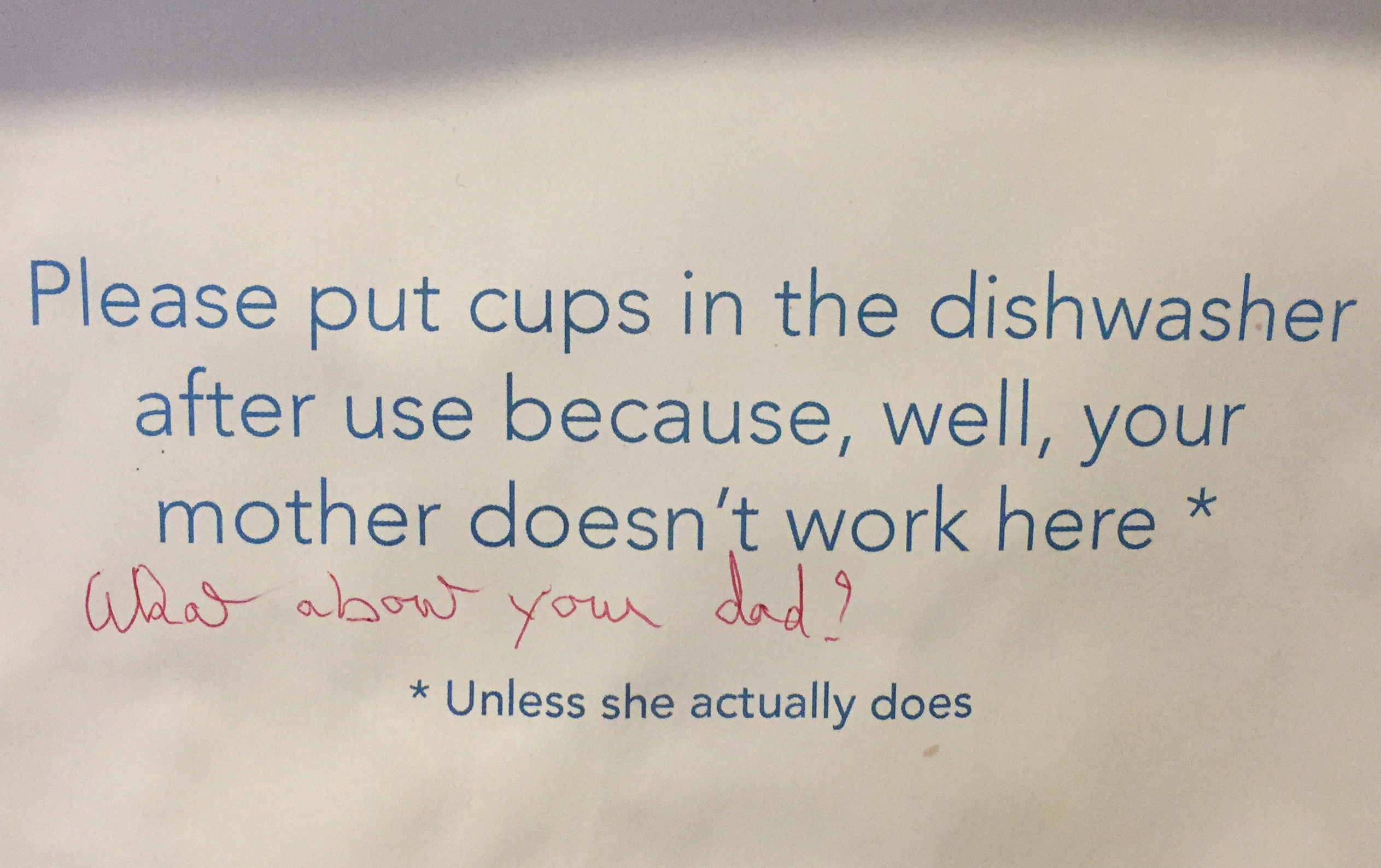
I have a desk in a co-work space. Taped to the wall above the sink there is a paper sign that reads “Please put cups in the dishwasher after use because, well, your mother doesn’t work here.”
I made my way to the co-work kitchen yesterday afternoon to brew water for a hot tea. I found a coworker leaning over the sink, scribbling on the paper sign. Your mother doesn’t work here, I read, in response to which she’d graffitied “What about your dad?”
The paper sign is insignificant. But the graffiti was important enough to give me pause. Behind it, there was outrage of some form. I share and applaud it.

 valk|fisher
Leave a comment