It was easy to love London. If not for the rain, if not for the food, then for its very particular brand of restrained orderliness.
I first discovered the Jubilee Line during rush hour. It was here that I understood British orderliness to be a form of cultural superpower, the epicenter of which seems to reside on the London Underground. If you are English you are of course allowed to disagree (but I would not dare. Speaking badly of the London Underground is like speaking badly about someone’s else’s family member. Only direct relatives are allowed the privilege).
But if you do disagree — about English orderliness on the tube — I encourage you to consider this statement as relative. See Paris below, where I pause to digress.
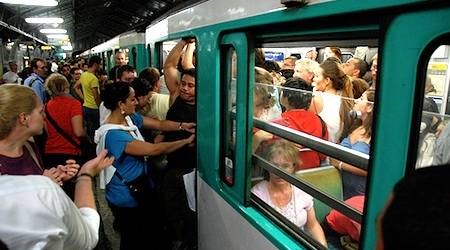
Photo credits: Adrien Paris
Where England had a an almost invisible hand coaxing orderly behavior, living in Paris showed me that France wielded a heavy one. The French have a cultural affinity for regulations and ordinances of all types in the overarching esprit of curtailing general happiness (take, for example, walking on grass, which is very strictly interdit in public gardens). Other examples of prohibited free-spirit activities include wearing yoga pants in public, preferring steak well-done, drinking too much – or not at all, which constitutes a similar type of offense.
Rules made the country go round. There were formal frameworks for everything, even for activities of disorder, such as striking, rioting and having affairs, and often there was a parliamentary regulation one might refer to. Breaking these types of unwritten rules had immediate consequences, implying varying degrees of social ostracism and/or immediate identification as an uncivilized American, which was basically the same thing.
I was a junior lawyer working in a mice-infested third-floor office on a small side-street with poor light exposure off of the Champs Elysees. Miriam was a junior attorney-waif from Lyon. She and I ate lunch together when there was time and only frequented establishments that did not involve braving the mobs in line at the Abercrombie & Fitch store on the Champs. Miriam and I often worked late. After 8 PM, she would shut the door to our office and chain smoke hand-rolled cigarettes. Sometimes, she opened the window. I asked her one evening if indoor smoking wasn’t prohibited? Feeling sorry for my American self, Miriam explained that French rules are made for breaking if you can do so in style and behind closed doors.
This contradiction summarizes aspects of my feelings about Paris, a city that is at once rigid but can stretch at the edges for those who are somehow ‘in.’
English orderliness by comparison felt very democratic, where everyone was invited to fit in by participating in the civic duty of keeping calm.
For some time, I commuted to Canary Wharf along with 105,000 other sleepy employees in skyscraper desk jobs. Bodies lined up early in neat two-person rows as they waited to board the Jubilee Line, and could be mistaken for a small army of soldiers in trench coats being called to arms out east, wielding umbrellas and to-go coffees.
There is no pushing. There is absolutely no cutting. There is merely a queue in order of arrival, which begins safely behind the designated line that I remember as yellow. Eye contact is limited; you might keep your gaze fixed at your shoes or on yesterday’s Evening Standard, respectfully minding your own business or the tabloids, and if for some reason you are obligated into a conversation, you might discuss the weather or your dog. You board the tube car in order of arrival, standing to the side to clear the way for any passengers getting off. You give up your seat for the woman with the Baby On Board pin, even though she is not showing. You glare at the person who does not. The tube car smells of beer and Earl Grey, but you carry on.
This English orderliness that I so love seems inextricable from restraint.
This was another reason I loved London. Restraint serves many functions, and it can make life considerably more interesting. After a stint in New York, it was a profound delight to no longer work in a city where your superior was constantly entreating you to go fuck yourself. This was the way of Wall Street firms, which left little room for the imagination, because it was pretty obvious when people were dissatisfied or having a bad day. The English light touch was comparably exhilarating. It opened up all sorts of interpretational possibilities.
Your boss says your work was “quite good”. This is food for an entire afternoon of thought. Quite as in very? Sort of? Almost? Half-way?
Your co-worker likes to say “no worries” when you haven’t expressed any worry at all. Is this because you shouldn’t worry? Or maybe you seem worried? Maybe you should have worried and this is a hint? The possibilities are endless.
I recently attended a talk about Brexit, a subject that polarizes (but, as the speaker put it, “At least you’re not in America, where things are far worse”). I witnessed a Brexit March. Despite the strong opinions, England again had me smitten with its flair for restraint.





 valk|fisher
Leave a comment