I recently drafted a will, and a living directive. For all the other childless 32-year-olds out there, please do not judge. (I promise I can be fun.)
I’m aware it is peculiar to be the type of person who even cares to get this done — a will, I mean. Statistically there should be no urgency, but I suppose attention to this type of thing counts amongst the many and diverse occupational hazards of being a lawyer.
I would much rather have avoided it altogether. The task was painful, awkward and somehow inescapable. It made me want to shut my eyes and grit my teeth, reminiscent of “the sex talk” with mom – was I 12? 13? I have tried very hard to forget.
I, having no knack for procrastination, still managed to fend off the encounter with my living directive, and with my will, for about eight years (since I graduated from law school, to be exact). This procrastination has been a feat that, for me, required active effort and willful neglect of my ongoing to-do list, which is otherwise a matter of some priority in life.
A few weeks ago I crossed “living will” off of my list. I’d too long lived in the inevitable guilt of an unfinished checklist, which for me can generate all sorts of background anxiety – legal occupational hazard number two.
Also, I can see I will some day go.
Of course I have long known this, that lives come to an end. But my life running its course? Understanding this, in a way that even approaches profundity, has taken time.
Do I sound self-entitled? I assure you I know there’s nothing special about me. Why would I be the lucky duck to live ad eternum? Actuarial statistics aside, my track record with the likes of bingo and raffles has never been any good. Even if it were a real thing, the deathless life is a lottery I’d be highly unlikely to win anyway.
This is the human weakness. Hypochondriacs and pessimists aside, we tend to think of ourselves as the exception for the better. We know of all sorts of diseases that afflict other people, but we couldn’t possibly imagine them befalling us, or a loved one. We have all heard repeatedly that half of married folk divorce (this is a one-liner that, while apparently inaccurate, was reinforced relentlessly in the Fisher household). And yet: no one puts a ring on it with a realistic view of our statistical probability of joining the statistic. It will not happen to me.
I can see that I will go. I am no exception. I’m harvesting the fine lines to prove it. College students look so young. I am on the way.
Death as concept has been front of mind. While I blame estate planning, I suspect this preoccupation is the occupational hazard of the writer. (Is the inevitability of death not why we write of life?)
The documents are now drafted and filed.
Now, I seek solitude and quiet.
To live the days allotted to me, with earnestness. Now, I want to be alone in a room with a door that is shut and I want, urgently, to write. (Yes, I do see the irony here, that time before laptop is perhaps not the best way of sucking the juice out of life, and this hereby exposes yet another occupational hazard of the writer – so I also invoke days with books and travel and special faces and my favorite island).
I am afraid I’m running out of time. Time being impossible to capture – literally, anyway – we seek to do so metaphorically. And so we engage in all sorts of clichés: we live in the moment, we seize the day, we carpe fuck-it, as New Yorkers say.
Zadie Smith writes about our fraught relationship with time, our tragic view of the thing being the “gospel of our culture,” for, the way we see it, “Time is not on our side. Every minute of it means one minute less of us.” (“Killing Orson Welles at Midnight,” Feel Free).
And because gospels – cultural or otherwise – become immediately suspect to me, I’ve set out to reconsider some things.
I cannot take the credit. In my first semester of law school, in a Criminal Law course, a classmate named Greg raised his hand and asked whether capital punishment was not a profoundly archaic sanction. This stuck with me.
A few months ago over dinner with Pete, I mentioned that characterizing lives as “short” or “long” may ultimately not the most relevant descriptor, the universe being, after all, around 14 billion years old (give or take several million years). Say we live to be luckily 100? This is the universe’s chump change.
None of this is to say that life is meaningless. That we experience “life” overflows with significance. But I suspect our “selves” and “lives” and “legacies,” on the contrary, have no meaning whatsoever. Could it make sense that the preciousness is in the whole, not the individual parts?
I am an optimist by education and attorney by training, so I’ve tried to work around the inevitability of death. Our time will one day be up, but what if I can find the loophole? What if time is not a measure of quantity, or of anything measurable, really? My living directive, my imperative to the self, is to see my passage through time as a qualitative exercise. This is not easy for me to do, having for years tracked my time and billed clients in four-minute increments. But when I enter the qualitative dimension of time, I am immediately more free. There is space. My possibilities are unlimited, which is an upgrade from the ticking clock, which indefatigably reduces all options, second by second.
I seek to choose the qualitative dimension of time.
There was that February afternoon in Vienna. Pete and I spent the final daylight hours outside. We skipped the guidebook’s museums, after feeling guilty and then getting over it. We lounged on the steps of a monument, facing west.
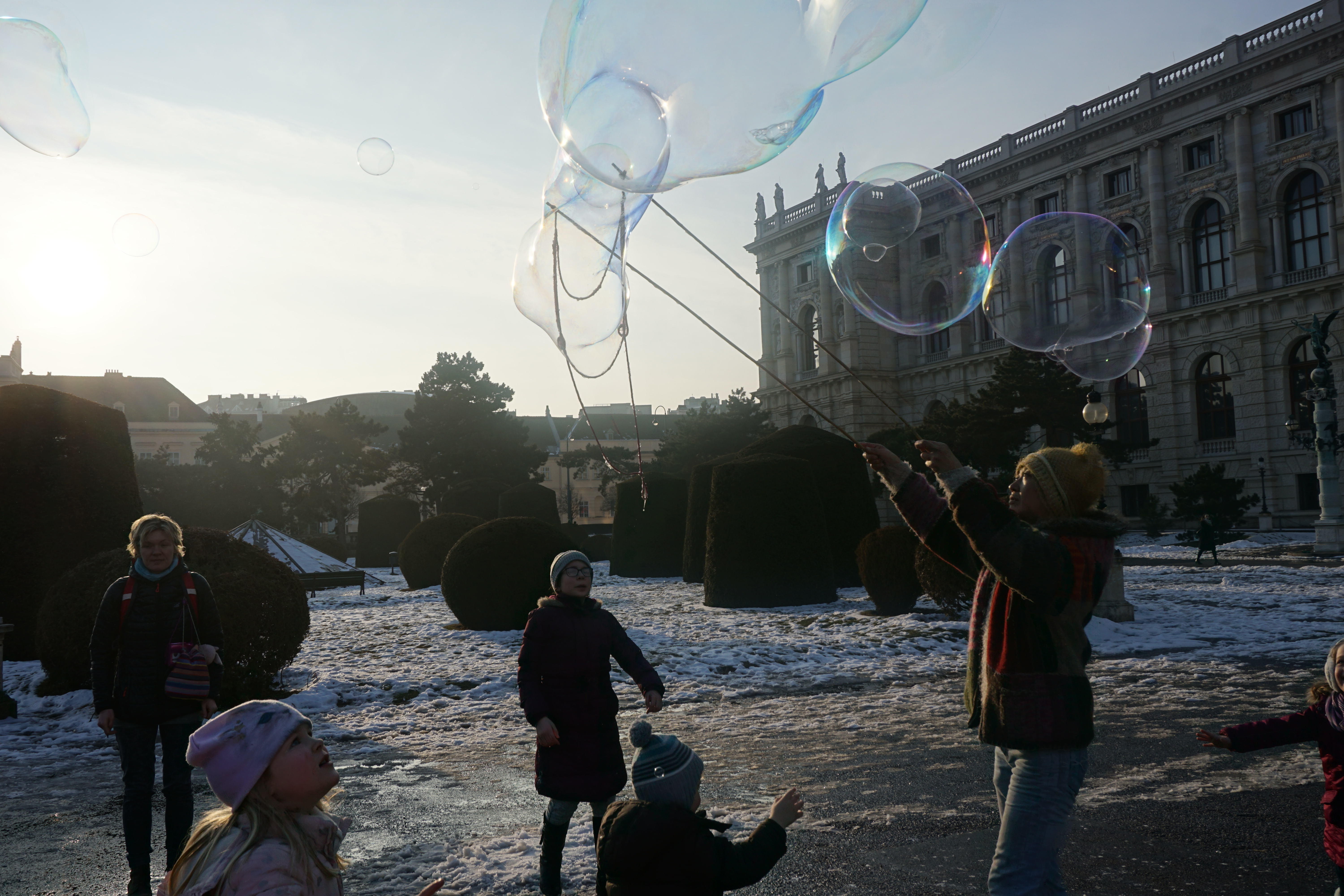
Sunlight reflected off of blue snow, and this made the streets of Vienna glow. By the front steps of the Ringstraße, there was a woman making bubbles. Children and their parents congregated around her, the bubbles a spectacle. She made them with an oversized sling, the ends of which she dipped in soapy water. As she moved the sling through air, bubbles in all sorts of shapes were born. They were large and small. The large ones were irregular in form. The bubbles pulsated like jellyfish above children’s hat-covered heads, reflecting rainbow scenes from the MuseumsQuartier. There were bubbles on bubbles, one merging into another. The bubbles floated aimlessly, for only moments. And then they popped, disappearing into the afternoon.
To lose physical form and disappear into nothing. It is the greatest fear.
I’ve had to Google all of this, having forgotten the entirety of my Science: bubbles are no more than captured air. Water and soap are together a viscous liquid, which, when stretched across a surface, creates a low-tension filmy sheet. This sheet can stretch as it passes through air, capturing it. When the filmy sheet comes into contact with solids, or when it overly-expands, it pops, the magical technicolor film coming to an end. But the magic, I can see, is not the outer film at all. The essence is what we cannot see. The meat of it is the air – what is always invisibly around us.
What if our physical selves are merely rainbow film? We come into being improbably, reproductive sex cells fertilizing their way to compatible cells, giving rise to lungs and a heartbeat and in forty weeks, a new bubble is born. It varies in shape and in size as it floats through a temporary world, for the briefest moment, before the bubble pops.
Maybe our end is neither the end of our time nor the end of ourselves. A bubble’s exterior film will inevitably break. But the air that was once trapped inside will continue to exist. It may take on improbable forms. It could become rain. It could become ocean. It could become ether.
Sometimes I come across words or content or art in a way that can feel serendipitous (but maybe it isn’t serendipity: by sheer volume of material read, I am bound to run into something that feels relevant).
Last week I devoured a book, Sheila Heti’s newest piece of nonfiction. In Motherhood, Heti considers a central question of adulthood: does she wish to have a child? In a late-novel scene, the narrator meets a good friend’s newborn child. The baby is lying in its bassinette. The narrator, in response:
“The baby seemed to me a glimmering fish in a silvery net, a shining and throbbing soul; it didn’t matter what it did with its life, just being here was the thing. I see how our lives are not about action, are not about contemplation, they’re just about being here, suspended in life’s net – here for such a short time, glinting and glittering against the sun, lifted out of the ocean’s depths to where everyone can see it, then plunged back in again – anonymous, gone.”

 valk|fisher
Leave a reply to Amy Cancel reply